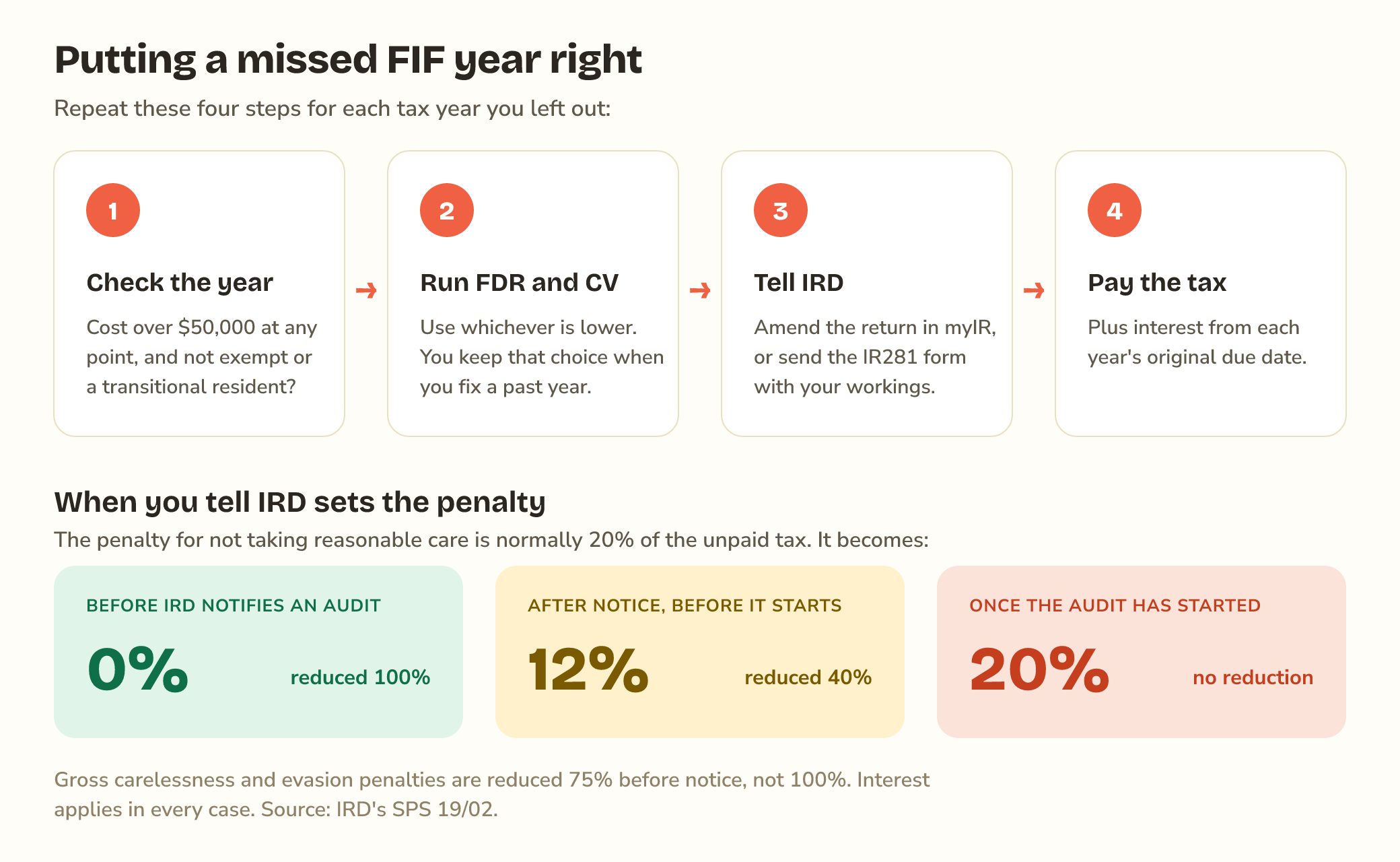
If you had undeclared FIF income in past years, you can still fix it, and you still get to choose FDR or CV for each year as if you'd filed on time. IRD confirmed that in 2023. Tell IRD before it tells you, and the usual penalty for an honest miss (20% of the unpaid tax for not taking reasonable care) is reduced by 100%. What you can't avoid is the tax itself plus use-of-money interest from each year's original due date. If IRD accepts the miss was an honest one, the real cost is the tax you'd have paid anyway, plus interest.
This guide covers who actually needs to go back, how far, what it costs, and the steps to put each year right. If FIF tax is new to you, read what FIF tax is first.
Why this keeps coming up
Since 2018 New Zealand has received account information every year from overseas tax authorities under the Common Reporting Standard (CRS). Australia and the UK take part; the United States doesn't, and runs its own system instead. IRD's guidance on FIF methods in cases of non-compliance (QB 23/10) includes an example of exactly this: IRD learns about someone's overseas shares "through its annual automatic exchange of information programme", writes to ask whether their tax affairs are in order, and issues assessments for the missing years when the letter is ignored.
IRD's own numbers suggest plenty of people are in this position. Figures released under the Official Information Act showed 18,140 people declared FIF income for the year ended March 2023, and tax specialist Terry Baucher told Good Returns in October 2024 that he was "really quite astonished" at how low that was.
First, check you actually owed anything
Plenty of people who worry about this had nothing to declare. Go year by year, because each tax year (1 April to 31 March) is tested on its own:
- Under the threshold. If the total cost of your overseas shares stayed at or under NZ$50,000 for the whole year, the FIF rules generally didn't apply. You only needed to declare the dividends you received. The de minimis guide explains how cost is measured.
- Exempt holdings. Most ASX-listed Australian companies and anything held through KiwiSaver or a NZ PIE fund don't count. See FIF exemptions.
- New arrivals. If you were a transitional resident in a given year, FIF income for that year was exempt.
If a year passes all three checks, there's no FIF income to correct for it. If you also left out the dividends in an under-threshold year, that's a smaller fix of the same kind.
You still choose FDR or CV for each year
IRD issued QB 23/10 (14 December 2023) because people weren't sure about this, and the answer is worth real money. Asked "does a person have a choice of methods when they make a voluntary disclosure or file a late return?", IRD's answer is a plain yes. An individual correcting past years can work out FIF income under both FDR and CV and use whichever is lower, separately for each year.
If you leave it until IRD issues a default assessment instead, that assessment will usually be based on FDR, and CV isn't available. You can still challenge that by filing the return with your own figures, but in a flat or falling year, the default can be far higher than what you'd have chosen.
💡 Good to know: if you declared your overseas dividends in those years but not FIF income, you don't pay tax on both. IRD's own example has the taxpayer paying tax on the difference between the FIF income and the dividends already returned.
Penalties: why going first matters
A shortfall penalty is a percentage of the tax you underpaid. How big it is depends on how careless IRD thinks you were, and how much it's reduced depends on when you speak up. IRD's statement on voluntary disclosures (SPS 19/02) sets the reductions:
| Shortfall penalty | Rate | Disclosed before IRD notifies an audit | Disclosed after notice, before the audit starts |
|---|---|---|---|
| Not taking reasonable care | 20% | reduced 100%, so 0% | reduced 40%, so 12% |
| Gross carelessness | 40% | reduced 75%, so 10% | reduced 40%, so 24% |
| Evasion | 150% | reduced 75%, so 37.5% | reduced 40%, so 90% |
Once an audit has actually started, a disclosure earns no reduction at all. Which category applies is IRD's decision, based on the facts. Someone who didn't know the FIF rules existed is in a very different place from someone who knew and hid the income, and IRD's 2026 interpretation statements on reasonable care (IS 26/04) and gross carelessness (IS 26/06) set out how it draws the line.
SPS 19/02 also says IRD's usual practice is not to prosecute anyone who makes a full disclosure before being notified of an investigation.
Interest and late filing
Two costs remain however early you come forward.
Use-of-money interest runs on each year's unpaid tax from the date it was originally due. IRD's rate for underpayments has been 8.97% a year since 16 January 2026 (current rates). It isn't a penalty and voluntary disclosure doesn't reduce it, so it keeps growing the longer the fix waits.
Late filing penalties can apply if you should have filed an IR3 for a year and didn't, for example because you were on automatic assessment and FIF income meant you needed to file. For an individual it's $50 a return with net income under $100,000, and $250 from $100,000 up to $1 million.
How far back you need to go
IRD normally can't increase a tax assessment once four years have passed from the end of the tax year you filed in. That time bar doesn't protect a return that leaves out income of a particular nature or from a particular source (section 108(2) of the Tax Administration Act 1994), and IRD's operational statement OS 16/01 notes the omission doesn't have to be deliberate for the exception to apply. A return with no mention of FIF income at all is likely to fall within it, although each case turns on its facts.
In practice, go back to the first year you were over the threshold. The calculator covers the 2020-21 to 2025-26 tax years. If your problem years start earlier than that, those need working separately, and an accountant is worth paying for.
Worked example: three missed years
Mia moved about $70,000 into a US index fund through a NZ broker in 2021 and never declared FIF income. All figures are in NZD. She earns $130,000 a year, so her marginal rate is 33% throughout. The US withholds 15% of her dividends, which gives her a foreign tax credit each year.
| 2022-23 | 2023-24 | 2024-25 | |
|---|---|---|---|
| Value on 1 April | $80,000 | $78,500 | $95,000 |
| Value on 31 March | $78,500 | $95,000 | $112,000 |
| Dividends (before US tax) | $1,600 | $1,700 | $1,900 |
| FDR (5% of opening value) | $4,000 | $3,925 | $4,750 |
| CV (closing + dividends − opening) | $100 | $18,200 | $18,900 |
| She uses | CV: $100 | FDR: $3,925 | FDR: $4,750 |
| NZ tax at 33% | $33.00 | $1,295.25 | $1,567.50 |
| Foreign tax credit | −$33.00 | −$255.00 | −$285.00 |
| Tax to pay | $0.00 | $1,040.25 | $1,282.50 |
Her total is $2,322.75 of tax. The foreign tax credit in 2022-23 is capped at the NZ tax on that year's FIF income, so $207 of the US tax she paid that year goes unused.
If she ignored it and IRD assessed all three years on FDR, the 2022-23 bill alone would be $1,320 of NZ tax less $240 of credit, an extra $1,080 compared with her own figures. Because she comes forward first, the 20% shortfall penalty is reduced to nothing. She still pays use-of-money interest on the 2023-24 and 2024-25 amounts, roughly $300 at IRD's recent rates if she settles at the end of 2026.
Putting it right, step by step
- List the years. For each tax year, check whether the total cost of your FIF shares went over $50,000 at any point. Those are the years to correct.
- Gather each year's numbers. You need the value of each holding on 1 April and 31 March, every buy and sell with its date, dividends received, and foreign tax withheld. Your broker's annual statements and transaction exports have all of it; the broker guide lists which file to download from Hatch, Sharesies, IBKR and Tiger.
- Calculate both methods for every year. Work out FDR and CV, take the lower, and convert everything to NZD with a consistent exchange-rate method. Keep the workings: IRD expects a breakdown per FIF when more than one sits behind your total.
- Work out the tax difference. Take the tax on your income with the FIF income added, subtract what you were assessed, then subtract each year's foreign tax credit. That's the shortfall for the year.
- Tell IRD. For a return you filed, use "Amend return" against that year in myIR and give the reason. Where myIR won't let you, send a message in myIR, post the IR281 voluntary disclosure form, or call. A full disclosure covers which years, why the income was left out, and enough detail for IRD to assess it correctly.
- Pay, or arrange to. IRD sends a new assessment for each year. If the total is more than you can pay at once, ask about an instalment arrangement before the due date rather than after.
Then file the current year properly. How to file FIF income in your IR3 covers boxes 17A and 17B.
If IRD has already written to you
It depends on what the letter says. SPS 19/02 includes an example of IRD writing to a taxpayer to confirm the details of a transaction it has heard about from another agency. That letter is not a notification of a pending investigation, and when the taxpayer replies with the full shortfall, it still counts as a voluntary disclosure. A CRS-prompted "please confirm your overseas income" letter reads much like that example.
A formal notice that IRD intends to audit you is different. Disclosing after that point gets the 40% reduction, not 100%, and nothing once the audit is underway. Either way, reply before any deadline in the letter, and if it mentions an audit or investigation, get a tax adviser involved before you respond.
When to bring in an accountant
You can correct a few simple years yourself in myIR. Get help if any of these apply:
- the missing years go back before 2020-21, or the totals run to tens of thousands of dollars;
- the shares were held by a trust or company, or you had foreign super or life insurance as well as shares;
- you have received a notice of audit or a default assessment;
- you knew about the FIF rules at the time and chose not to declare.
In short
- You can fix past years at any time, and you still choose FDR or CV for each one (IRD, QB 23/10).
- Check every year against the $50,000 threshold and the exemptions first. Some years may need no change.
- Disclose before IRD notifies you of an audit, and the 20% penalty for not taking reasonable care is reduced to zero.
- Use-of-money interest applies from each original due date, currently 8.97% a year, and it grows while you wait.
- The four-year time bar generally doesn't protect a return with FIF income left out.
- If IRD assesses you first, it will usually use FDR, which can cost far more in a flat year.
Common questions
Can I just declare FIF income from this year onwards and leave the past alone?
You can, but it doesn't make the earlier years go away. The four-year time bar generally doesn't apply where a return omits a whole category of income, so IRD can still reassess those years. If it finds them first, you lose the full penalty reduction and get FDR by default.
Will I be penalised for not knowing the rules?
Possibly, but if you disclose before IRD notifies you of an audit, a not-taking-reasonable-care penalty is reduced by 100%. IRD decides which penalty category applies, and SPS 19/02 notes that some unprompted disclosures attract no penalty at all.
Do I have to use the same method for every past year?
No. An individual can choose between FDR and CV each year, and that choice survives a voluntary disclosure. Calculate both for every year and take the lower one each time.
I declared my overseas dividends but not FIF income. What do I owe?
Tax on the difference. Under FDR and CV the dividends are part of the FIF calculation, not separate income, so you replace the dividend figure with the FIF income figure and pay tax on the increase.
Should I amend in myIR or fill in the IR281 form?
Either counts as a voluntary disclosure. The myIR amend option is quickest for a return you filed online. The IR281 form or a myIR message suits several years at once, or a year where you never filed an IR3.
Does the calculator work for past years?
Yes, for the 2020-21 to 2025-26 tax years, each calculated separately with that year's tax brackets and IRD exchange rates. Run one year at a time and keep each year's workings for your disclosure.
Sources: IRD QB 23/10, FIF calculation methods in cases of non-compliance (14 December 2023); IRD SPS 19/02, Voluntary disclosures; IRD shortfall penalties, make a voluntary disclosure and fix mistakes in my IR3; IRD OS 16/01 on s 108 of the Tax Administration Act 1994; Guide to foreign investment funds (IR461).
This guide is general information, not tax advice. Always verify figures against IR461 and your year-end statements, and check anything important with a qualified NZ accountant before filing.